Pakistan, Bangladesh sign MoUs to deepen ties
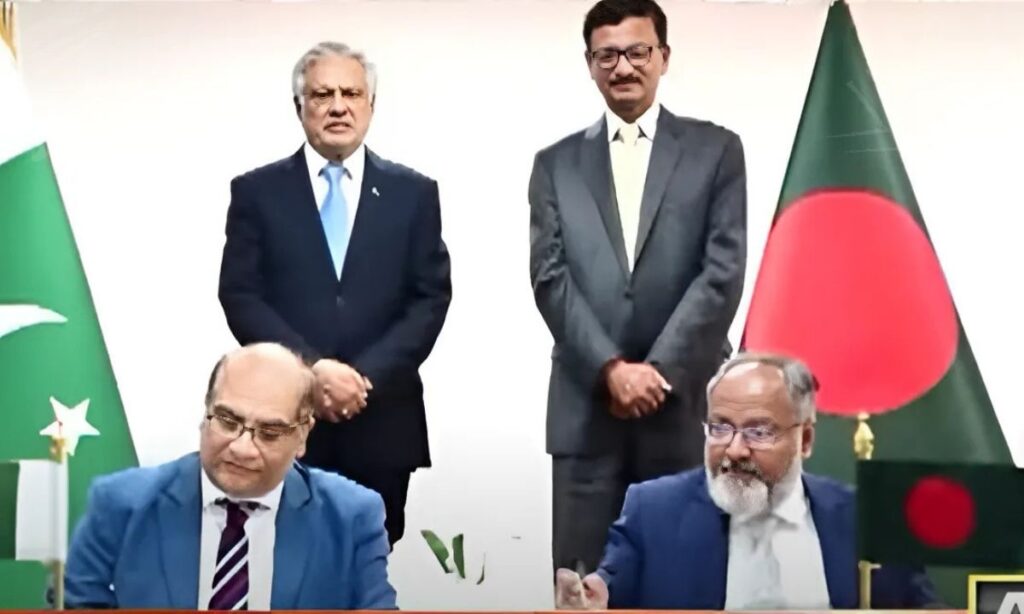
Agreements on visas, trade, culture, and news cooperation mark the most senior Pakistani visit to Dhaka in over a decade.
Pakistan and Bangladesh on Saturday signed a series of agreements in Dhaka aimed at strengthening bilateral ties, with Deputy Prime Minister and Foreign Minister Ishaq Dar becoming the most senior Pakistani official to visit the Bangladeshi capital since 2012. The visit, hailed by Islamabad as a “significant milestone in Pakistan-Bangladesh relations,” covered multiple areas of cooperation, ranging from diplomatic facilitation to trade and cultural exchange.New Dawn in Pakistan–Bangladesh Ties After Hasina’s Exit
The agreements, signed under the supervision of Dar and Bangladesh’s Adviser for Foreign Affairs Md Touhid Hossain, included the abolition of visas for diplomats and government officials, collaboration between the foreign service academies of the two countries, and an agreement between national news agencies Associated Press of Pakistan (APP) and Bangladesh Sangbad Sangstha (BSS). Additional memorandums of understanding covered institutional cooperation between the Institute of Strategic Studies Islamabad and the Bangladesh Institute of International and Strategic Studies, the establishment of a Joint Working Group on Trade, and the launch of a Cultural Exchange Programme for 2025–2028.
The talks, described by both sides as constructive, also reviewed high-level exchanges, economic cooperation, educational linkages, cultural engagement, and humanitarian collaboration. Regional issues such as the revitalisation of the South Asian Association for Regional Cooperation (SAARC), the Palestinian conflict, and the Rohingya refugee crisis were discussed, according to official statements. The Bangladesh Foreign Adviser hosted a luncheon in Dar’s honour following the talks.
Dar, accompanied by Pakistan’s Commerce Minister Jam Kamal Khan, also met Bangladesh’s Adviser for Commerce Sk. Bashir Uddin, as well as senior officials including Bangladesh Bank Governor Dr. Ahsan H. Mansur, the Chairman of the National Board of Revenue Md. Abdur Rahman Khan, and senior representatives from the ministries of textiles, commerce, civil aviation, and tourism. Discussions centred on boosting trade, investment, and connectivity between the two countries.
During a reception hosted by Pakistan’s High Commissioner to Bangladesh Imran Haider, Dar reaffirmed Pakistan’s intent to build a cooperative and forward-looking relationship, stressing that ties between the two countries are rooted in shared traditions, Islamic heritage, and cultural expressions. He also met with Bangladeshi political delegations to discuss reforms, youth engagement, and regional developments.
The latest diplomatic outreach marks a shift from the strained relations of recent years. Former foreign minister Hina Rabbani Khar was the last senior Pakistani official to visit Dhaka in 2012, when she invited then-Prime Minister Sheikh Hasina Wajid to the D-8 summit. Hasina’s 15-year tenure saw tensions with Islamabad, particularly over historical grievances stemming from the 1971 war.
Recent developments, however, signal a thaw. In February, Pakistan and Bangladesh inaugurated their first direct maritime trade link, and both sides have agreed to resume direct flights. Defence ties have also seen a revival: in January, Lt-Gen S M Kamr-ul-Hassan, Principal Staff Officer of Bangladesh’s Armed Forces Division and the second-highest ranking military officer, paid a rare visit to Pakistan.
These moves come amid a shifting regional balance following the ouster of Hasina’s government earlier this year. The former prime minister, widely regarded as pro-India, fled to India after her removal and has since lived there in exile. Bangladesh’s interim government has called for her extradition to face trial on multiple charges, but New Delhi has not responded.
The realignment of Pakistan-Bangladesh relations has raised concerns in India, where officials and analysts fear that closer ties between Islamabad and Dhaka could affect security in India’s northeastern states. Both Pakistan and Bangladesh have dismissed such apprehensions, insisting their renewed engagement is driven by mutual benefit and a desire to broaden cooperation.
Dar’s visit is being closely watched as both countries attempt to reset ties after more than a decade of limited engagement. Analysts note that the agreements signed in Dhaka lay the groundwork for broader economic and cultural collaboration, signalling intent on both sides to move beyond past frictions. With the establishment of new trade and defence linkages, Pakistan and Bangladesh appear committed to deepening relations in ways that could reshape South Asia’s diplomatic landscape.
The visit, rooted in a call for shared heritage and mutual respect, has opened a new chapter in Pakistan-Bangladesh relations. Whether this momentum will be sustained depends on the success of the signed agreements and the political will in both capitals to prioritise cooperation over historical grievances.