New Dawn in Pakistan–Bangladesh Ties After Hasina’s Exit
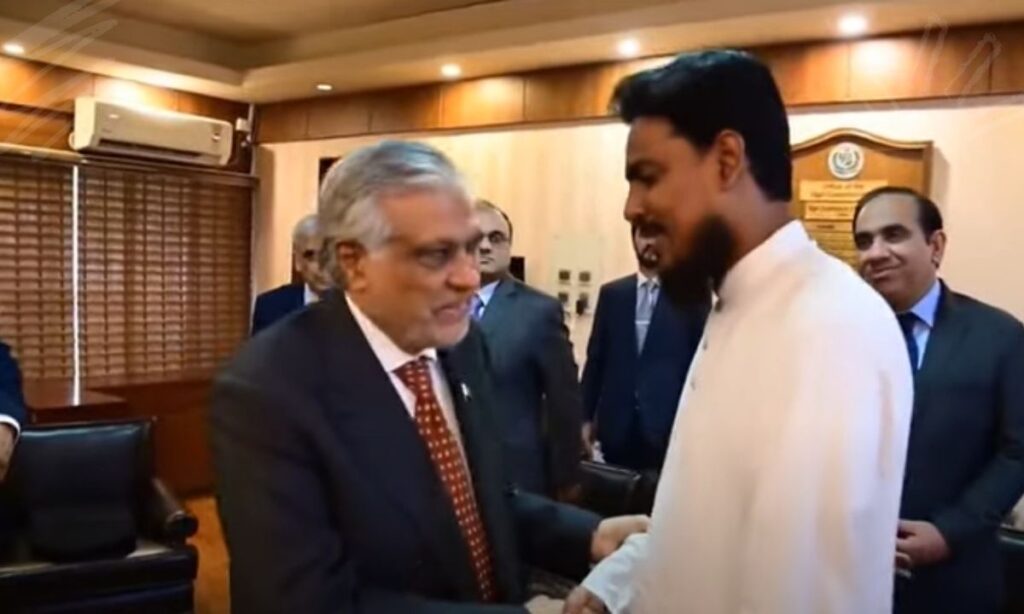
Pakistan’s Foreign Minister Ishaq Dar’s landmark visit to Dhaka marks the start of a new chapter in bilateral ties, as both countries signal readiness to move past decades of mistrust following the dramatic exit of Sheikh Hasina’s government.
The foreign minister arrived in Dhaka on August 24, 2025, becoming the first senior Pakistani official to visit Bangladesh in more than a decade. The trip was symbolic not only for its timing but also for the weight of expectations attached to it.

For years, ties between Islamabad and Dhaka remained frozen under Hasina’s Awami League government, with issues rooted in the 1971 war of independence dominating the relationship. The fact that Pakistan’s deputy prime minister was received in the Bangladeshi capital, holding talks on trade, investment, and security, underscored that the political ground in South Asia has shifted dramatically, according to Tribune India.
The historical baggage between the two nations is heavy. Since Bangladesh’s secession in 1971, relations have been punctuated by mistrust, stalled diplomacy, and recurring demands. Dhaka has consistently raised three issues: a formal apology from Islamabad for the events of 1971, reparations estimated at $4.5 billion, and repatriation of thousands of stranded Pakistanis still in camps. These grievances were reemphasized earlier this year when the two governments resumed official dialogue after a 15-year break. In April 2025, Dhaka bluntly placed these unresolved demands on the table, yet the very act of dialogue was hailed as progress, AP News reported.
Hasina’s fall in July 2024 proved to be the critical turning point. Swept away by a mass uprising dubbed the “July Revolution,” she left behind a deeply divided country and a political vacuum. Her Awami League party was banned, her closest allies arrested, and the towering figure of her father, Sheikh Mujibur Rahman, once revered as the “father of the nation,” came under intense scrutiny.
In a remarkable reversal, Mujib’s legacy has been questioned and in some quarters, deliberately erased. Public memorials tied to his name have been vandalized, and political narratives have shifted away from his nationalist credentials. Some factions even called for a new historical framing, with Pakistan reemerging as a point of reference for Bangladesh’s identity, Economic Times reported.
The Bangabandhu Memorial Museum at Dhanmondi 32, a contested symbol of Sheikh Mujibur Rahman’s legacy (Alamy)
The interim government that took over has moved quickly to rebalance foreign policy. Under Hasina, Dhaka leaned heavily towards New Delhi, relying on India for economic, political, and security support. This alignment came at the cost of strained ties with Islamabad, Beijing, and even at times Washington.
The post-Hasina regime has recalibrated. In the span of a year, Bangladesh has engaged more actively with China and Pakistan, sought to mend fences with the Gulf, and demonstrated a readiness to chart a less India-centric course, according to Anadolu Agency.
Street unrest in Dhaka during the July Revolution, 2024–25 (Getty)
Yet the path ahead is far from smooth. Bangladesh remains deeply polarized. Operation Devil Hunt, launched in early 2025, continues to target thousands of Awami League supporters. Human rights organizations have criticized the arrests and restrictions, warning that the government risks replacing one form of authoritarianism with another.
Alongside this, the revival of Jamaat-e-Islami (JeI)—long banned for its role in the 1971 war—has unnerved many. JeI’s return, openly welcomed by some in Pakistan, signals an ideological undercurrent in the thawing relations. Critics argue that Dhaka’s anti-Hasina actions and pro-JeI moves are closely connected according to Economic Times.
At the same time, Bangladesh is struggling to stabilize internally. The economic cost of the uprising and its aftermath has been heavy. Inflation, unemployment, and capital flight have all increased, while political uncertainty has slowed investment.
The interim government is under pressure to secure external partnerships that can shore up confidence and bring relief to the economy. Against this backdrop, closer ties with Pakistan, alongside China and Gulf states, are seen as part of a survival strategy.
In Pakistan too, the timing is significant. With economic pressures at home and a turbulent neighborhood, Islamabad is eager to demonstrate that it is not isolated. Engagement with Bangladesh allows Pakistan to signal regional relevance, build trade networks, and showcase a pragmatic approach. The idea of a “Pakistan–Bangladesh confederation,” floated by some political figures, may be little more than rhetoric, but it reflects a wider ambition of creating stronger institutional frameworks for cooperation, Wikipedia reveals.
The question remains whether this “new dawn” will endure. Trust fractured over five decades cannot be restored overnight. Bangladesh’s internal instability, Pakistan’s own economic fragility, and India’s likely unease all complicate the process. Yet the symbolism of Ishaq Dar in Dhaka, talking trade instead of history, is powerful. It signals that the political winds in South Asia are shifting, and that pragmatism may—at least for now—be taking precedence over old wounds.
For Dhaka and Islamabad, the future may not lie in erasing history, but in building a parallel narrative of cooperation, where economics, connectivity, and diplomacy become the currency of engagement. Whether this fragile opening matures into a sustained partnership will depend on how both countries manage their politics at home and their expectations abroad.