SMEDA Board Weighs New CEO Appointment
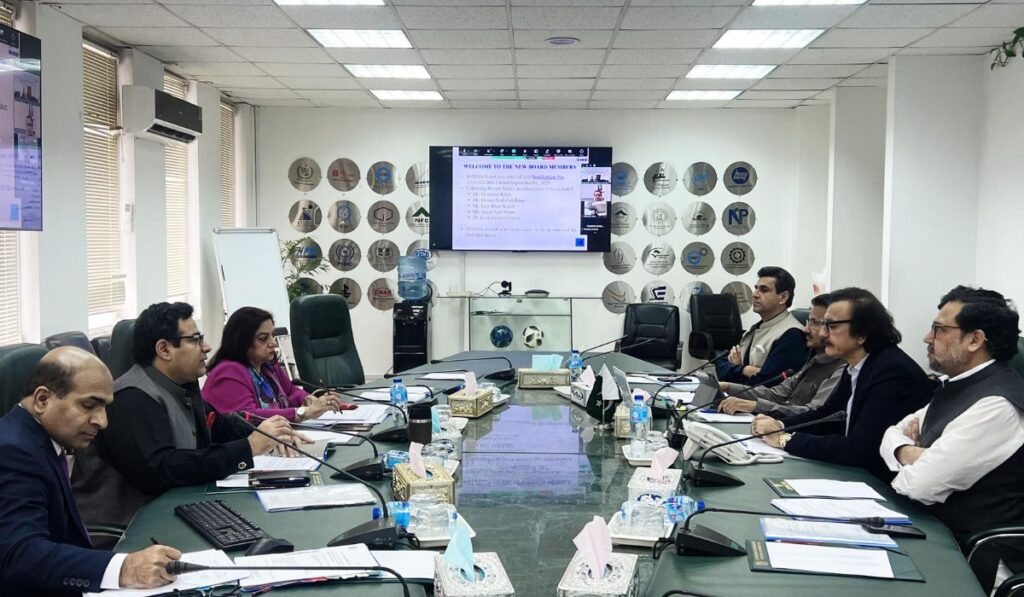
The 31st meeting of the Small and Medium Enterprises Development Authority (SMEDA) Board, chaired by Special Assistant to the Prime Minister on Industries and Production Haroon Akhtar Khan, placed the appointment of a new chief executive officer at the center of its agenda.
Held in Islamabad on September 12, the board meeting brought together senior officials including Secretary Industries and Production Saif Anjum, outgoing CEO Soqrat Aman Rana, and other members. The session also welcomed newly inducted board members, reflecting a renewed direction for the authority under the federal government’s oversight.
Haroon Akhtar Khan opened the meeting by underlining that Prime Minister Shehbaz Sharif had finalized SMEDA’s new organizational structure, shifting its focus towards an outsourcing-based model and enhancing its capacity for policy and program design. He emphasized that the reforms are intended to reposition SMEDA as a driving force in supporting small and medium enterprises across Pakistan.
According to Khan, the authority’s work will increasingly target micro-enterprises, women entrepreneurs, and projects tackling climate-related challenges, aligning with the Prime Minister’s broader economic and social priorities. He further announced the establishment of regional SMEDA offices in Azad Jammu & Kashmir, Balochistan, and Gilgit-Baltistan to expand outreach and accessibility.
The most pressing decision before the board was the appointment of a new CEO. The Human Resource Committee was tasked with finalizing the process, with Khan stressing that transparency and merit would be the defining criteria. “The appointment of the CEO will strictly be on merit. There will be no compromise on transparency and fairness,” he said, noting that Prime Minister Sharif has personally directed an immediate and accountable selection procedure.
Khan highlighted SMEDA’s potential to transform Pakistan’s business landscape by enabling entrepreneurship and job creation. “SMEs are thriving and expanding every day, and SMEDA has a crucial role to play in shaping this growth,” he remarked, reiterating the authority’s responsibility to serve as a catalyst for economic development.
The SAPM also underscored that a stronger SMEDA would be central to government efforts to empower women-led enterprises, bolster regional development, and integrate environmental priorities into business practices. Such initiatives are expected to contribute to inclusive growth, especially in underrepresented areas like Balochistan and Gilgit-Baltistan where small businesses often lack formal support structures.
Read More: Zahid Mir to Step Down as PRL CEO After Six-Year Tenure
SMEDA, established in 1998, has long been tasked with facilitating policy advocacy, business development services, and capacity-building for Pakistan’s SME sector. Over the years, the authority has faced criticism for limited effectiveness due to resource constraints and fragmented strategies. The government’s new restructuring effort aims to address these shortcomings and align SMEDA’s operations more closely with national economic goals.
Industry analysts note that Pakistan’s SME sector, which constitutes over 90 percent of businesses and employs nearly 80 percent of the non-agricultural workforce, is critical for economic resilience. However, challenges such as limited access to finance, inadequate infrastructure, and regulatory hurdles continue to hold back its potential. Strengthening SMEDA’s capacity could therefore be decisive in addressing these gaps.
The upcoming CEO appointment is being seen as a test case for the government’s commitment to reform. A transparent and merit-based selection would signal seriousness about revamping institutions, while a politically influenced process could undermine confidence among entrepreneurs and investors.
As Pakistan grapples with sluggish growth and rising unemployment, policymakers are betting on the SME sector to generate sustainable economic momentum. Haroon Akhtar Khan’s assurances suggest that SMEDA will be placed at the forefront of this agenda, with the new leadership expected to play a defining role.
The meeting concluded with consensus that the authority must evolve into a more dynamic and responsive institution, capable of delivering on its expanded mandate. Whether the new CEO can translate this vision into practical impact will likely shape SMEDA’s trajectory in the years ahead.
In reaffirming his commitment, Khan stated that Prime Minister Shehbaz Sharif views SMEDA as a cornerstone of industrial policy and a platform for inclusive growth. The forthcoming appointment will therefore not only determine the authority’s leadership but also reflect the government’s resolve to back reforms with credible action.
By the close of the session, participants echoed the sentiment that empowering SMEs through a revitalized SMEDA is not only an economic necessity but also a social imperative. The final decision on the new CEO, expected in the coming weeks, will mark a pivotal step in this restructuring effort.