Flood-hit Gilgit-Baltistan roads restored after federal aid
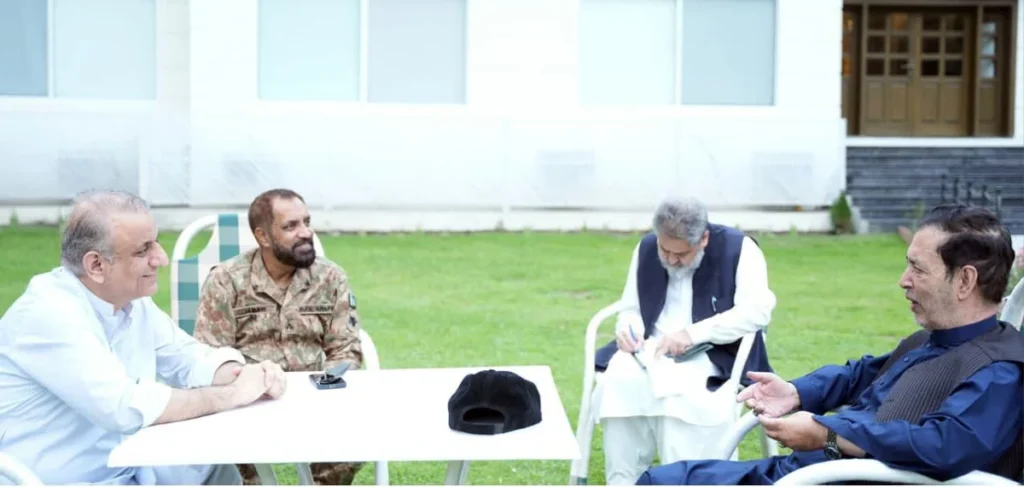
Federal Minister Abdul Aleem Khan and Governor Mehdi Shah reviewed road restoration and relief efforts following floods in Gilgit-Baltistan.
ISLAMABAD: Federal Minister for Communications Abdul Aleem Khan held a key meeting in Gilgit with Governor Gilgit-Baltistan Syed Mehdi Shah to review the province’s situation after heavy floods and torrential rains disrupted life and transport networks. The two leaders discussed ongoing relief operations, restoration of damaged highways, and federal support for the region’s recovery.
Governor Mehdi Shah praised the rapid emergency response carried out by the National Highway Authority (NHA) under the Ministry of Communications. He noted that the timely deployment of heavy machinery in difficult terrain was instrumental in reopening crucial roads, helping reconnect remote districts cut off by landslides and flooding. “The efforts of the NHA in such circumstances are commendable, as restoring road access has been critical for relief operations,” the governor said.
NHA speeds up road repairs in flood-hit Khyber Pakhtunkhwa
Both leaders expressed grief over the loss of lives and property caused by the floods in several districts but agreed that close coordination between federal and provincial institutions had accelerated the reopening of transport routes. Governor Shah also thanked Minister Abdul Aleem Khan for personally visiting Gilgit-Baltistan during the crisis to oversee rehabilitation work.
Minister Abdul Aleem Khan described the flooding as a major challenge for Gilgit-Baltistan but emphasized that the response was immediate. He said that NHA, the Frontier Works Organization (FWO), and other federal agencies deployed extra machinery and workforce from Punjab and Sindh from the very first day of the disaster. He added that his personal visit to Gilgit-Baltistan underscored the federal government’s commitment to ensuring the swift restoration of highways vital for mobility and relief distribution.
The discussions also covered progress on strategic routes such as the Naltar Expressway, Babusar Road, and Ghizer Expressway, which were heavily affected by the recent torrential rains. Minister Khan informed that restoration work on these highways was being monitored daily, with NHA staff and heavy machinery deployed continuously at damaged sections. He assured that the authority would remain on-site until full restoration was achieved.
Officials highlighted that reconnecting Gilgit-Baltistan’s road network was essential not only for immediate relief supplies but also for safeguarding tourism and trade in the mountainous region, which heavily depends on transport corridors. The reopening of routes like Babusar Road, a critical link between Gilgit-Baltistan and Khyber Pakhtunkhwa, is expected to ease the movement of goods and travelers.
Abdul Aleem Khan further said that the coordination between agencies had significantly accelerated restoration. According to him, highways were gradually reopening as landslides were cleared and temporary routes established. “Strong collaboration among NHA, FWO, and local authorities has been the backbone of our progress in reopening transport links,” he noted.
The federal government’s visible presence in Gilgit-Baltistan during the crisis marks an important step in addressing the province’s vulnerability to natural calamities. Gilgit-Baltistan, due to its mountainous geography, is prone to flash floods, cloudbursts, and landslides, which frequently damage road infrastructure and cut off valleys from essential supplies. In recent years, similar monsoon floods have repeatedly disrupted the Karakoram Highway and other arterial routes, underscoring the need for long-term disaster-resilient planning.
Observers point out that restoring road connectivity in Gilgit-Baltistan goes beyond short-term relief, as the region serves as a strategic hub for trade and tourism. Road closures not only delay relief but also affect the movement of tourists and goods along the Karakoram Highway, a lifeline connecting Pakistan with China under the China-Pakistan Economic Corridor (CPEC). Ensuring rapid restoration is therefore viewed as critical for both humanitarian and economic reasons.
While the current restoration efforts have provided relief to stranded communities, local voices have urged the government to strengthen early warning systems and invest in flood-resilient infrastructure to reduce the recurring impact of monsoon rains. Experts also stress that more resources should be allocated to remote valleys that remain underserved compared to main highways.
As Gilgit-Baltistan continues its recovery, both the federal and provincial leadership pledged to maintain close coordination to ensure that road connectivity is fully restored and that relief supplies continue reaching affected communities without disruption. Abdul Aleem Khan reiterated that the Ministry of Communications would remain engaged until all highways were operational and expressed confidence that with combined efforts, normalcy would return to the province soon.
The meeting concluded with a joint commitment to not only restore the roads damaged by recent floods but also strengthen long-term resilience measures to protect Gilgit-Baltistan’s vital transport lifelines from future natural disasters.